 (954) 249-2314
Best 1000 Watt Solar Generator: Sizing and Runtime
If you need portable power for your essentials, a 1000-watt solar generator gives you enough output to run a compact refrigerator, medical devices, lights, and personal electronics during an outage. Most units in this class pair a 1000-watt inverter with about 1,000 watt-hours of battery storage.
Whether you're a homeowner or a camper, you'll find this size light enough to carry, and it still covers your emergency essentials. Our pick here is the Jackery Solar Generator 1000 which gives you 1,000 watts of continuous output, a 2,000-watt surge rating, and a 1,002Wh battery.
Realistic Expectations for a 1000-Watt System
It's easy to mix up output and capacity when you're buying your first power station. The continuous 1000-watt rating is the most power you can draw at one time. The bigger the battery capacity, measured in watt-hours, the longer you can keep those devices running.
Run each of these on its own, and a 1000-watt power station will keep it going for about this long:
- A 60-watt portable car fridge: 12 to 15 hours.
- A CPAP machine without a heated humidifier: two to three nights.
- LED camp lights and a laptop charger together: several days.
- A standard home internet router and modem: up to 18 hours.
Plug in several at once, and you'll get less time from each. Keep an eye on the starting wattage, though. Appliances with compressors, like compact refrigerators, draw a brief surge of power when they start up. Many 1000-watt inverters can handle surges of up to 2,000 watts, but if you run a high-draw appliance continuously, you'll drain the battery quickly.
You also lose some energy along the way. Inverter efficiency runs between 85 and 90 percent, and the cooling fan and display draw a little power too, so a 1,000-watt-hour battery gives you about 850 usable watt-hours.
When you're comparing backup options, remember that a battery power station produces no exhaust, so you can run it indoors as long as you follow the manual's ventilation, clearance, and temperature limits. Fuel-burning portable generators are a different story. They need a steady fuel supply, and you have to run them outdoors, because a single portable generator can put out as much carbon monoxide as hundreds of cars.
There isn't really a single option that will be perfect for every emergency, though. With a solar power station, you won't have fumes indoors, and you can recharge it from sunlight, a car outlet, or a wall outlet when the grid is up.

Safety Standards and Battery Construction
If you're bringing energy storage into your living space, then you definitely need to ensure battery quality and certification. Any portable power station you buy falls under UL 2743, the standard for portable power packs, which caps total lithium-ion battery capacity at 20 kilowatt-hours and covers the onboard outlets and charging ports.
Just don't confuse a portable station with a permanent home energy storage system. A permanent system has to meet UL 9540 and follow building-code placement rules, so have an electrician confirm where yours can go before you install it.
Poorly made lithium packs can overheat and catch fire (thermal runaway), so be careful what you buy. You can see how serious this gets in the HALO 1000 portable power station recall, which the Consumer Product Safety Commission announced because of fire and burn hazards. And if you ever need to get rid of a damaged or recalled lithium battery, never put it in your household trash, since it can start large, serious fires unbelievably quickly.

Recommended Brands and Configurations
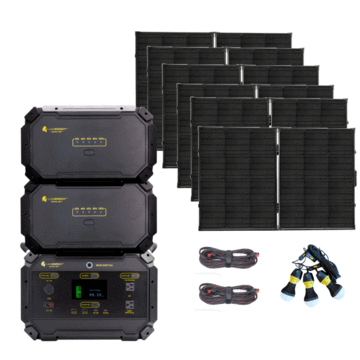
We recommend that you stick with established brands that have solid battery management software. Take the Explorer 1000 from our Jackery solar generators lineup. It comes with three AC outlets, USB-A and USB-C ports, and a car outlet, and you can recharge it from a wall outlet in about 7 hours. You'll need to buy the solar panels separately. Pair the Explorer 1000 with two SolarSaga 100W panels, and you can recharge it in about 8 hours of full sun.
Do you want to add batteries later or recharge faster from the wall? Then take a look at our Anker solar generators, which include compact units like the SOLIX C800 Plus (768Wh, 1,200W). Many newer units like these use lithium iron phosphate (LFP) batteries, which you can charge several thousand times before you'll notice the capacity dropping.
In a camper van or travel trailer, you can use a compact station to keep your lights, fans, and small DC loads running without idling the engine. You'll find more mobile setups in our solar generators for RVs.

Sizing Above 1000 Watts for Larger Loads
A 1000-watt generator will cover your personal essentials, but you can't use it to power heavy household loads. For a microwave, a coffee maker, a full-size refrigerator, or a circular saw, head to our guide to 2000-watt solar generators.
Are you planning to run a couple of essentials at once, like a refrigerator and a sump pump? If so, check out our guide to 3000-watt solar generators. And if your combined loads are heavier than that, you'll find the next step up in our guide to 4000-watt solar generators.
For well pumps, electric water heaters, and other 240-volt loads, read our guide to 5000-watt solar generators. As long as you match your load list to the inverter size, you'll avoid overload trips when an emergency hits.
Practical Tips for Outage Readiness
Once you've bought the generator, add it to your household emergency plan well before severe weather arrives.
First off, work out how long it will take you to recharge. For the Explorer 1000 with two 100W panels, that's about 8 hours of full sun, and longer under clouds or when the sun is low.
Next, look after the battery between uses. Keep your power station in a climate-controlled room at the charge level its manual recommends, and check the charge every so often.
Finally, get your cords ready and test your critical appliances now. Plug in your medical gear and refrigerator this weekend so that you can see how much power they draw. That way, when hurricane season starts, you'll know exactly how long you can run them, and you won't get hit by any nasty surprises.
Frequently asked questions
Can a 1000-watt solar generator power a CPAP with the humidifier on?
It can, but if you use a heated humidifier, you'll get a lot less runtime. Test your complete setup, and size the battery based on the energy you measure your CPAP using overnight.
Can I connect a 1000-watt solar generator to my home's breaker panel?
Only if the station and your connection equipment support panel integration. Otherwise, plug your appliances straight into the station. For any transfer equipment or panel wiring, you'll need a compatible setup and a qualified electrician.
Can I add more solar panels?
Yes, but only if you stay within the station's solar-input voltage, current, and wattage limits. Be sure to check those specs before you connect a larger array.
Can the station charge while powering appliances?
It depends on the model. Some support pass-through charging, while others limit output or protect the battery differently. Before you rely on it during an outage, test whether you can charge the station and run your appliances at the same time.
← Older Post Newer Post →