 (954) 249-2314
Best Propane Generators: Top Picks for Home Backup
The best propane generators in most situations are dual-fuel or tri-fuel portables that run on propane and gasoline, or on all three fuels including natural gas. At All Pro Generators, propane questions come up constantly during hurricane season, and the real conversation is almost always about fuel flexibility rather than propane alone.
What makes propane worth choosing
Propane stores cleanly and indefinitely without the stale-fuel problems gasoline creates over long storage periods. For a backup generator that sits ready for months, that matters. You can top off a tank before hurricane season, leave it alone, and have fuel ready when the lights go out.
The honest trade is output. Propane has roughly 73% of the energy content of an equivalent volume of gasoline, so a generator rated at 10,500 running watts on gasoline will typically deliver around 9,500 watts on propane. That gap rarely breaks the deal, but it means you should size your purchase using the propane numbers, not the gasoline peak.
Propane also burns cleaner than gasoline, which means less carbon buildup and easier maintenance over time. That matters if you plan to run the generator for extended outages rather than just testing it once a year.
Five things to settle before you choose a model
- Your critical load list, including startup surge. A refrigerator pulls 150 to 400 running watts but can surge to 800 to 1,200 watts at startup. A half-horsepower well pump runs at 750 to 1,000 watts and surges to 1,500 to 2,000 watts. A furnace fan and a sump pump carry comparable startup demands. Ignoring startup surge is the most common reason a generator feels underpowered after purchase.
- Portable deployment versus permanent connection. A large portable is not a whole-home standby system unless it is connected through a proper transfer switch or interlock installed by a licensed electrician. Extension cords limit you to plug-in loads. Powering hardwired circuits, overhead lights, a well pump, or a water heater requires a transfer switch, and that work needs to be done before a storm threatens.
- Propane-only, dual-fuel, or tri-fuel. Most of our propane-capable inventory runs on propane and gasoline, with tri-fuel models adding natural gas. In a storm, having more than one fuel option is a genuine advantage if supply chains are disrupted. We always ask buyers whether they have a natural-gas line before steering them toward a tri-fuel model.
- Tank size and vaporization capacity. A 20-pound grill cylinder holds about 4.7 gallons of propane. For a large generator under sustained load, that cylinder can empty quickly, and in cold weather a small cylinder may not vaporize propane fast enough to maintain full output. High-wattage portables typically need a 40-pound minimum tank; many serious backup setups use 100-pound cylinders.
- Clean power versus maximum output. If you are running electronics, a modern furnace control board, or sensitive equipment, a low total harmonic distortion figure matters. Conventional open-frame generators can produce higher THD, which is fine for tools, lights, and appliances but potentially problematic for sensitive loads. Inverter-style units or models with published THD under 5% are the cleaner choice.

The strongest propane-capable options by use case
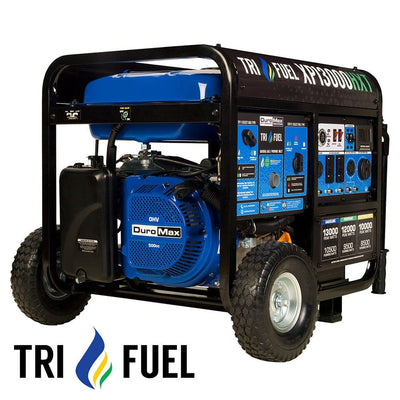
Best high-output option: DuroMax XP13000HXT Tri-Fuel
For homeowners or small businesses that need serious wattage with full fuel flexibility, the Duromax XP13000HXT Tri-Fuel Generator is the model we point people to most often in this category. It delivers 12,000 peak and 9,500 running watts on propane, or 13,000 peak and 10,500 running watts on gasoline. Adding natural gas as a third option makes it one of the most flexible propane-capable generators available in a portable format.
The outlet panel includes a 14-50R, an L14-30R, an L5-30R, and four 5-20R GFCI receptacles, making it transfer-switch ready and compatible with a wide range of connection setups. DuroMax publishes a THD below 5%, which puts it in better territory than many conventional open-frame portables for sensitive loads. Published noise is 74 dB, reasonable for a generator in this output class.
A few practical notes before you order.
This generator weighs 240 pounds dry, so unloading and positioning it requires two people and ideally a ramp or liftgate delivery.
DuroMax specifies a 40-pound minimum propane tank for this model, which is worth noting if you expected to run it from a standard grill cylinder.
Runtime on propane runs about 13 hours at 25% load and 6.5 hours at 50% load from a 40-pound cylinder.
The package includes a propane regulator, a natural-gas hose, a CO Sensor Shutdown feature, and a 5-year warranty.
Best mid-range dual-fuel option: Cummins Onan P9500DF
The Cummins 9500 dual-fuel (Onan P9500DF EFI) is a strong mid-range propane-capable choice, rated at 6,750 running and 8,550 peak watts on propane, and 7,500 running and 9,500 peak watts on gasoline. It covers essential home loads comfortably: refrigerator, sump pump, furnace fan, lights, and basic electronics. Cummins is one of the brands we carry, and their standby engineering heritage gives the Onan line a level of support that lighter-duty brands cannot match.
The P9500DF includes automatic CO shutoff, electric and remote start, GFCI outlets, and transfer-switch readiness.
One number to keep in mind: its published THD is up to 23%, which is on the higher end.
It is a solid conventional portable, not an inverter-style unit, so we would not steer someone toward it if clean, stable power for sensitive electronics is the primary goal.
For refrigerators, pumps, fans, and basic lighting, it performs well.
Runtime on a standard 20-pound propane cylinder is published at 10.8 hours at 25% load.
Best for clean power: inverter-style dual-fuel units
If your priority is quiet operation, low THD, and compatibility with laptops, medical equipment, or modern furnace boards, an inverter-style dual-fuel generator is the right direction. Inverter generators electronically regulate output to stay under 5% THD in most designs, meaningfully cleaner than a conventional open-frame unit. They also throttle down under light load, which saves fuel and reduces noise during low-demand periods.
The trade is output ceiling. Dual-fuel inverter generators typically top out at lower wattage than a comparable open-frame unit, so they work well for light-to-moderate essential loads but are not the answer if you need to run heavy appliances or a large HVAC system.
Side-by-side comparison
| Feature | DuroMax XP13000HXT (Tri-Fuel) | Cummins Onan P9500DF (Dual-Fuel) | Dual-Fuel Inverter (category) |
|---|---|---|---|
| Propane running watts | 9,500 W | 6,750 W | Varies (typically 2,000 to 5,000 W) |
| Gasoline running watts | 10,500 W | 7,500 W | Varies (typically 2,200 to 6,000 W) |
| Third fuel | Natural gas | None | None |
| THD | <5% | ≤23% | <5% (inverter design) |
| 120/240V output | Yes | Yes | Model-dependent |
| Transfer-switch ready | Yes (14-50R, L14-30R) | Yes (L14-30R) | Model-dependent |
| CO shutoff | Yes | Yes | Most models |
| Noise (published) | 74 dB | 74 dBA | Lower (inverter throttles) |
| Min. propane tank | 40 lb | 20 lb | 20 lb (light loads) |
| Best fit | High-load home/business, max fuel flexibility | Mid-range home backup, storm prep | Electronics, RV, low-load quiet use |
The DuroMax XP13000HXT earns the top spot on output, fuel flexibility, and power quality for a conventional portable. If you are comparing fuel types, our guide to the best diesel generators covers durable options for demanding backup power needs. The Cummins P9500DF is a dependable mid-range choice if you do not need the third fuel option and your critical load list fits within the propane wattage. Inverter-style dual-fuel units serve quiet, clean-power needs rather than whole-home wattage, which is a genuinely different use case.
Propane tank sizing and connection basics
A standard 20-pound grill cylinder holds about 4.7 gallons of propane. For a small inverter generator running lights and a refrigerator, that can cover a useful stretch. For a large open-frame generator under heavy load, that same cylinder empties fast, and in cold weather it may not vaporize propane quickly enough to sustain full output.
A 40-pound cylinder holds about 9.4 gallons and is the practical minimum for high-output portables. The PERC Measurements and Cylinder Size Chart lists a 40-pound cylinder at 9.4 gallons and 860,542 Btu. A 100-pound cylinder holds about 25 gallons and supports extended runtime, though at that size most homeowners need help transporting it for refilling. Some buyers pair multiple 40-pound cylinders so they can swap without a gap in power.
Check the connection fitting carefully before running any propane generator. Many generators include hoses designed for standard 20-pound QCC/Type 1 cylinders, while larger cylinders often use POL connectors that require a different adapter or hose. Always check connections for leaks with soapy water or a leak-detection solution before starting.
How to make the final call
- List your critical loads. Write down the running watts for everything you genuinely need to power during an outage.
- Add the largest startup surge. Identify the single motor load with the highest startup draw, such as a well pump or sump pump, and add that number on top of your running-watt total. That combined figure is your minimum usable output on propane.
- Decide how you will connect the generator. Extension cords work for a few plug-in appliances. Powering hardwired circuits requires a transfer switch or interlock kit installed by a licensed electrician before storm season begins.
- Choose your fuel flexibility level. If you have natural gas at the house, a tri-fuel model gives you the most options. If you only have access to gasoline and propane, a dual-fuel portable covers both scenarios. Our dual fuel generators and tri-fuel portable generators collections are organized by output range and use case.
- Match the propane tank size to your runtime needs. Factor in how long outages typically last in your area, how much load you will actually run, and whether you can safely store and transport 40-pound or larger cylinders.
- Order before the storm is named. Large generators ship by LTL freight carrier and typically take 5 to 9 business days to deliver, with liftgate scheduling required for residential addresses. Contact our team early and we will tell you honestly what can still ship in time.

The best propane generator for storm-prone areas is often one that does not limit you to propane alone. Consumer Reports’ guide to portable vs. whole-house generators explains that standby systems offer the gold standard in backup power, while a large portable connected through a transfer switch can provide similar capacity but still requires manual setup and operation Portable vs. Whole-House Generator: Which Is Right for You? - Consumer Reports. Stored propane for immediate backup, gasoline for flexibility, and natural gas for extended runtime is a meaningfully different level of preparedness than a single-fuel machine. The CDC recommends preparing well before a hurricane warning, since warnings may come only 36 hours before tropical-storm-force winds are expected Preparing for Hurricanes or Other Tropical Storms | CDC.
Understanding the benefits of having a generator can help you choose the right fuel mix and prepare more confidently for outages. If you are still working through your load list or unsure which connection method makes sense for your home, our USA-based specialists are ready to help you size the system correctly before the first outage of the season.
If gasoline is your preferred backup fuel, comparing the best gas generators can provide another useful option before you choose a system. If you are comparing permanent backup options, see our guide to the best standby generators for whole-home coverage.
Frequently asked questions
Can I run a propane generator from a 20-pound grill tank?
Some smaller propane generators can use a 20-pound cylinder, but larger models may need a 40-pound tank or larger for adequate fuel flow. Check the manufacturer’s minimum tank size, regulator requirements, and hose connection before buying.
Are propane generators safe to use during rain or snow?
They can be used outdoors in poor weather only when protected according to the manufacturer’s instructions, without enclosing the generator or blocking airflow. Keep the unit at least 20 feet from doors, windows, and vents, and never operate it in a garage, shed, or covered porch.
How do I know whether a propane generator will run my well pump?
Add the pump’s running watts and its startup surge, then include other appliances that may start at the same time. Well pumps can require substantially more power during startup, so a transfer-switch load calculation is safer than relying on the generator’s running-watt number alone.
Is a propane generator a good choice for long-term off-grid use?
Propane works well for stored emergency fuel, but continuous off-grid operation may require a larger tank, scheduled refills, and a generator rated for extended duty. For frequent daily use, compare propane with solar storage, diesel, or a tri-fuel setup based on runtime, maintenance, and fuel access.
← Older Post Newer Post →